Replace a concrete driveway when more than about a quarter of it is spalling, cracking in connected patterns, or settling — repair anything less. A full replacement in St. Louis runs from tear-out to drivable in roughly two weeks, and the first-year sealing decision matters as much as the pour itself.
Most St. Louis driveways don't fail from traffic — they fail from water and winter. BTS Outdoor Solutions & More has worked on concrete across Kirkwood, Webster Groves, Ballwin, and the rest of the metro since 1995, and the pattern repeats: a slab that made it 30 years was sealed and drained well; a slab that failed in 12 wasn't. This guide walks through the whole decision — when repair still makes sense, why Missouri winters are the real enemy, what a proper concrete driveway replacement involves step by step, how long it takes, what permits look like, and how to protect the new slab so you never do this twice.
Should You Repair or Replace Your Concrete Driveway?
Repair when damage is isolated: a few cracks, surface stains, or minor edge chipping. Replace when spalling or interconnected cracks cover roughly a quarter of the surface or more, when sections have settled unevenly, or when the base underneath has failed — patches over a failed base always come back.
The distinction that matters is cosmetic damage versus structural damage. Concrete is supposed to crack a little — that's why control joints exist — and a hairline crack that runs straight and stays tight is not a replacement trigger. The signals below are.
Repair Territory
- One or two isolated cracks under 1/4″ wide
- Oil, rust, or tire stains — a professional cleaning handles these
- Minor surface scaling in small patches
- Chipped edges near the apron or garage
- Failed joint caulk letting water into the joints
Replacement Territory
- Spalling (flaking, pitted surface) across large areas
- Alligator or map cracking — many connected cracks
- Slabs settled unevenly or rocking under a car's weight
- Cracks wider than 1/2″ or offset in height
- Drainage pitched toward the house or garage
Settlement and rocking deserve special attention because they indicate the problem is under the concrete. When the gravel base washes out or compacts unevenly, the slab above it loses support and cracks under load. Resurfacing or patching that slab treats the symptom; the base failure keeps working underneath. That's the scenario where replacement — with the base rebuilt correctly — is the honest recommendation, and it's the assessment we make on every estimate before quoting either option.
Why Does Missouri Freeze-Thaw Destroy Driveways So Fast?
Concrete is porous — it absorbs water, and water expands about 9% when it freezes. St. Louis winters swing above and below freezing dozens of times a season, so absorbed water freezes, expands, thaws, and refreezes over and over. Each cycle pries the surface apart a little more, producing the flaking called spalling.
This is why the same driveway design lasts decades in Phoenix and fifteen years here if it's neglected. St. Louis sits in the worst band for freeze-thaw: cold enough to freeze regularly, warm enough to thaw again days later. A January week that runs 45°F on Tuesday and 18°F on Thursday puts more stress on a slab than a month of steady deep cold, because it's the cycling — not the cold itself — that does the damage.
Road salt makes it worse. Deicing chemicals lower the freezing point of water, which sounds helpful but actually increases the number of freeze-thaw cycles the moisture in your concrete goes through, and salt-laden meltwater dripping off parked cars concentrates the damage in wheel paths. Unsealed concrete absorbs all of it. We wrote a full companion guide on this — how to protect concrete from Missouri freeze-thaw damage — that covers sealing schedules, drainage, and deicer choices in depth.
For a new pour, freeze-thaw resistance is engineered in from the start: an air-entrained concrete mix (microscopic air bubbles give freezing water somewhere to expand), adequate strength (typically 4,000 PSI for driveways in this climate), and a cure that isn't rushed. Those three specs are worth asking any contractor about directly.
What Does the Driveway Replacement Process Look Like?
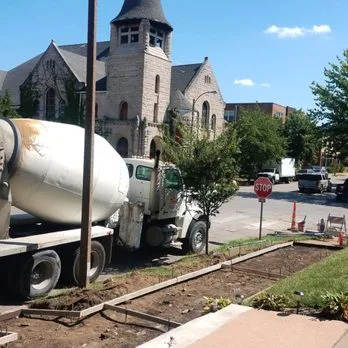
A full replacement has six stages: demolition and haul-off, base preparation, forming, reinforcement, the pour and finish, and jointing. The pour itself is one day; the base preparation before it is what determines whether the new driveway lasts 15 years or 40.
- Tear-out and haul-off. The old slab is broken up, loaded, and hauled for recycling. Any tree roots that heaved the old concrete are cut back and the subgrade is inspected.
- Base preparation. The subgrade is graded to drain away from the house, then a compacted granular base — typically 4″ or more of crushed stone — goes down in lifts. Skipping compaction here is the number-one cause of early slab settlement.
- Forming. Forms set the final shape, elevation, and slope. A driveway should fall roughly 1/4″ per foot away from the garage so water never ponds against the structure.
- Reinforcement. Steel rebar or wire mesh is placed on supports so it sits mid-slab, where it actually controls cracking — mesh lying on the base does nothing.
- Pour and finish. Air-entrained concrete is placed, screeded, floated, and finished with a broom texture for traction. Timing the finish to the concrete's set is craft — overworking the surface weakens it.
- Control joints. Joints are cut or tooled at regular intervals (spacing in feet at roughly 2 to 3 times the slab thickness in inches, cut to about a quarter of the slab depth) so the slab cracks along planned lines instead of random ones.
On sloped St. Louis lots — common in Sunset Hills, Fenton, and Wildwood — the same project sometimes involves a retaining wall or a stepped approach, which changes the forming and drainage plan. That's designed up front, not improvised on pour day.
How Long Does a Concrete Driveway Replacement Take?
Plan on one to three days of site work — tear-out, base prep, and forming — then a one-day pour, then curing: walk on it at 24–48 hours, park on it at 7 days, full design strength near 28 days. From demolition to parking your car, roughly two weeks.
Weather moves these numbers. Concrete cures by hydration — a chemical reaction, not "drying" — and that reaction wants moderate temperatures and retained moisture. Hot, windy summer days pull water out of the surface too fast, so summer pours here start early and get curing compound immediately. Cold is worse: if fresh concrete freezes in its first days, the surface strength is permanently compromised. That's why reputable St. Louis contractors get conservative about scheduling pours from late November through March, and why a driveway poured the week of a hard freeze at a discount is no bargain.
Do You Need a Permit to Replace a Driveway in St. Louis?
It depends on your municipality — and in the St. Louis area, that means dozens of different answers. Some St. Louis County municipalities require a permit for full replacement but not repair; others regulate width, drainage, or the apron where the driveway meets the public street. Your contractor should know which applies before work starts.
The metro is a patchwork: Kirkwood, Clayton, Webster Groves, Chesterfield, Ballwin, and unincorporated St. Louis County each handle driveway and right-of-way permits their own way. The apron — the section between the sidewalk or curb and your property line — is the piece most often regulated, because it sits in the public right-of-way. Widening a driveway or changing where it meets the street is more likely to trigger review than a same-footprint replacement.
None of this should land on the homeowner. We've navigated these requirements across the municipalities we serve for three decades, and we walk clients through what their specific city requires as part of the estimate — so a paperwork surprise never stalls a scheduled pour.
How Do You Protect a New Driveway After the Pour?
Three habits protect the investment: seal the slab after it fully cures (28–90 days), keep deicing salt off it entirely for the first winter, and keep water moving off the surface. Do those three things and a St. Louis driveway's 25-year lifespan stretches toward 40.
Sealing is the big one. A penetrating silane/siloxane sealer soaks into the pore structure and chemically blocks water absorption — which is why sealed slabs shrug off the freeze-thaw cycling that spalls unsealed ones. In Missouri conditions, penetrating sealers typically last 5–7 years per application versus 2–4 for topical acrylics, which is why our concrete sealing crews usually recommend penetrating products for driveways. The first application before the new slab's first winter is the single highest-value maintenance dollar you'll spend on it.
The rest is routine. Rinse off winter salt film in spring — an annual concrete cleaning also strips the grime and organic growth St. Louis humidity feeds all summer (if you're weighing how that's done safely, see our guide to pressure washing vs soft washing). Re-caulk control joints when the caulk cracks or pulls away, keep downspouts discharging past the slab edge, and use sand instead of salt for traction in year one. Small habits, decades of difference.
Driveway Replacement FAQ
How much damage means replacement instead of repair?
A common rule of thumb: when more than about a quarter of the slab surface shows spalling, interconnected cracking, or settlement, replacement usually beats patching on cost per year of service. Isolated cracks and surface stains are repair territory. Base failure — sections sinking or rocking — points to replacement, because new concrete poured over a failed base fails the same way.
How soon can I drive on a new concrete driveway?
Foot traffic is fine after 24–48 hours. Keep passenger vehicles off the slab for at least 7 days, when concrete typically reaches around three-quarters of its design strength. Concrete continues curing toward full design strength at about 28 days — keep heavy trucks, dumpsters, and moving vans off until then.
What time of year is best to replace a driveway in St. Louis?
Late spring through early fall is ideal — concrete cures best when temperatures hold between roughly 50°F and 85°F. Pours in St. Louis summer heat are managed with early start times and curing compounds; late-fall pours risk a freeze during the critical first days of curing, which permanently weakens the surface.
Do I need to seal a brand-new concrete driveway?
Yes, but not immediately. New concrete should cure at least 28 days before sealing, and penetrating sealers perform best after about 90 days, once the slab has finished most of its hydration. Sealing before the first winter matters most in Missouri — it blocks the water absorption that drives freeze-thaw spalling.